
 Hermit
Meta-Harness Adapter#
Meta-Harness Adapter is the outer loop of Meta-Harness (Lee et al., 2026, arXiv:2603.28052; code) with the search confined to the adapter. A coding agent, the proposer, reads a filesystem holding every earlier candidate’s files, scores and full execution traces, and writes k new candidates; each is evaluated on a fixed search set and logged to the same filesystem; the best on the search set is selected. Choose it when you have a labelled training split to search on, an acting agent you will not change, and a budget for evaluating every candidate on the whole search set.
What it is not. Meta-Harness searches over the whole harness program, the acting agent’s loop included: how it
calls the model, runs commands and decides it is done. Here the acting agent and its host are fixed, and the
proposer changes only the adapter: ADAPTER.md, which the agent reads as its instructions, and any other files it
adds, which reach the agent as the agent’s own deployment allows. Results of this method are results of adapter
search under a fixed agent, not of Meta-Harness itself.
Setup#
template: meta-harness-adapter
start_from: seed_adapter         # the starting adapter, the first candidate
evolver:
  name: meta_harness_adapter
  params:
    model: fireworks/accounts/fireworks/models/glm-5p3-flash   # the proposer's model
    k: 2                         # candidates per proposal round
    max_rounds: 6
data:
  step_size: 50                  # the whole training split (the search set) per step
  shuffle: false
trainer:
  epochs: 13                     # 1 + max_rounds x k: the starting adapter, then each candidate once
This fragment belongs in a complete run config. What the method needs from the run:
A training split, the search set. Every step evaluates one candidate on all of it, so
data.step_sizemust cover it. Validation data is not used.An acting agent that delivers the adapter.
ADAPTER.mdalways reaches the agent (What an adapter can rely on); what happens to the adapter’s other files depends on the agent, and the task information must say so, because the proposer learns it from there.A Codex or Claude Code CLI for the proposer, as the built-in
codexandclaudeEvolvers run it.
The template#
meta-harness-adapter fixes only .hermit/: its manifest and the proposer’s guide, EVOLVER.md. Every other file of
the adapter may be added, changed or removed, and the template declares no structure, no check of its own and no
exports. The guide says what an adapter is, that ADAPTER.md is the agent’s instructions at the start of every task,
and that anything else reaches the agent only if ADAPTER.md tells it what is there; what the adapter contains and
how it is organised is left to the proposer.
One framework step#
One step evaluates one candidate (data.step_size covers the search set, so a step is an epoch):
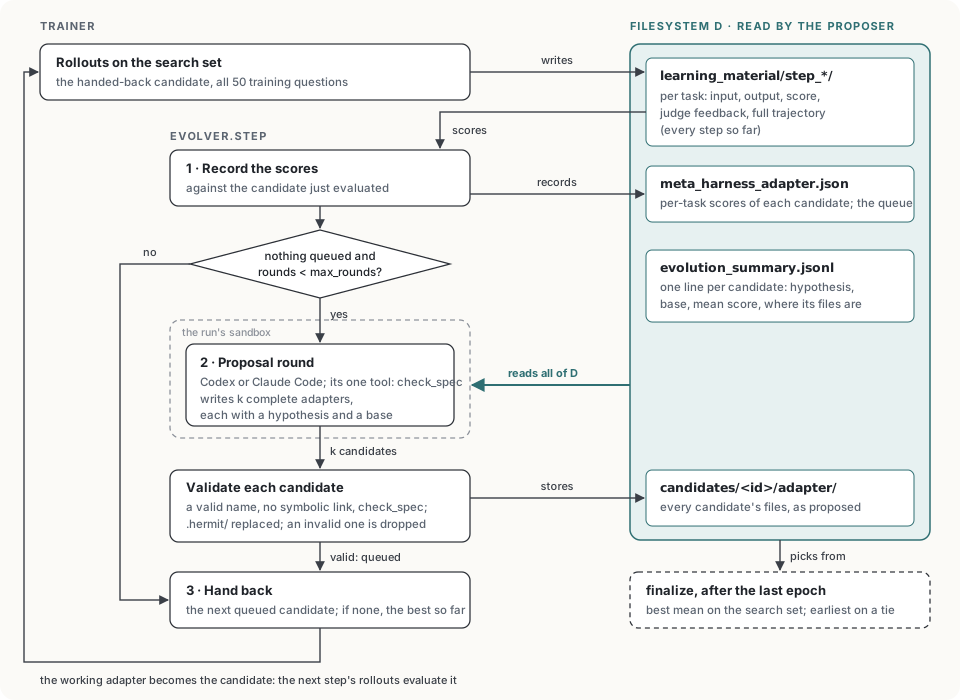
One step: the rollouts evaluate the candidate handed back last; a proposal round runs only when nothing is queued.#
The step’s rollouts are the evaluation of the candidate handed back last time (the starting adapter,
seed, on the first step). The Evolver records their per-task scores against that candidate.When no proposed candidate is waiting, a proposal round starts: the summary is brought up to date with this step’s scores, and a proposer session, with
check_specas its only tool, writes k candidates. Each must be a complete adapter in a real directory of its own; a candidate with a bad name, a symbolic link (its directory included) or a failingcheck_specis rejected and recorded with its problems. Its.hermit/is always replaced with the template’s. Valid candidates are stored, with a digest of their files, and queued.The next queued candidate is handed back, so the next step’s rollouts evaluate it. With nothing queued (
max_roundsreached, or no valid candidate), the best candidate so far is handed back and evaluated again; its score becomes the mean over all its evaluations. The proposer’s sandbox can writestate/, so before a stored candidate is handed back its files are checked against their digest: one changed since it was stored is markedtamperedand never handed back, its scores no longer describing its files.
finalize hands back the intact candidate with the best mean score on the search set; on a tie, the one evaluated
first.
Paper (Algorithm 1) |
Framework |
|---|---|
The filesystem D |
The Evolver’s |
The proposer |
An |
Interface validation |
|
Evaluation on the search set |
The Trainer’s rollouts of the next step, on the training split |
Selection |
|
The proposer never runs evaluations and never sees validation or test results. The round’s prompt carries the authors’ hard rules: write no facts about individual search tasks or their answers into a candidate, deliver all k candidates, do not run the evaluation.
Parameters and defaults#
description: The outer loop of Meta-Harness (Lee et al., arXiv:2603.28052) on the Trainer, confined to the adapter (the
  acting agent is fixed). A coding-agent proposer reads
  every earlier candidate's files, scores and trajectories and writes k new whole adapters; each is handed back in
  turn, so the next step's rollouts on the training tasks (the search set) evaluate it. finalize hands back the
  candidate with the best mean score on the search set.
class: evolver.py:MetaHarnessAdapterEvolver
needs: []
params:
  backend: codex             # the proposer: codex or claude (the paper: Claude Code)
  prompt: PROPOSE.md         # the round's prompt (placeholders filled per round)
  args: []                   # extra arguments for the proposer's CLI, e.g. codex `-c model_reasoning_effort="medium"`
  model: null                # the proposer's model, `<backend>/<model id>`; null: the agent's default
  price: null                # USD per million tokens {input, cached_input, output}
  home: [auth.json, .credentials.json]   # files of the agent's home copied into the run's
  tools: [check_spec]        # the only Trainer tools the proposer may use: it does not run evaluations
  web_search: false          # web search, set explicitly: Codex's hosted search runs at the provider, past the sandbox
  hide: null                 # paths hidden from the proposer besides examples/tests/docs/.git
  k: 2                       # new candidates per proposal round (the paper: 2-3; its TerminalBench-2 run: 1)
  max_rounds: null           # proposal rounds; null: a new round whenever every proposed candidate was evaluated,
                             # the last step's too (its candidates are never evaluated): set it to (epochs - 1) / k
Parameter |
Values / default |
Effect |
|---|---|---|
|
Positive integer / 2 |
Candidates per proposal round (the paper: 2-3; its TerminalBench-2 run: 1) |
|
Integer or null / null |
Proposal rounds; null starts a new round whenever every proposed candidate was evaluated, including on the run’s last step, whose candidates are then never evaluated. With |
|
|
The proposer and its model, as for the built-in agent Evolvers |
|
List / |
The Trainer tools the proposer may call; |
|
File name / |
The round’s prompt; its placeholders ( |
The rollout cost is (1 + R x k) x |search set| rollouts for R rounds, plus one proposer session per round.
Where this integration departs from the paper#
Dimension |
The paper |
Here |
Kind |
|---|---|---|---|
What the proposer may change |
The whole harness program, including the acting agent’s loop |
Every file of the adapter outside |
forced by the framework |
Selection |
A population with a Pareto frontier (for example accuracy against context length); the frontier is tested |
The best mean on the search set; one candidate is tested |
decision |
Parent selection |
None fixed: the proposer chooses what to build on |
The same: each candidate names its |
matched |
Proposer |
Claude Code with Claude Opus 4.6 at maximum effort |
Codex or Claude Code with the run’s choice of model |
a setting |
Interface validation |
The candidate imports |
|
forced by the framework |
Isolation |
— |
The proposer runs in the run’s sandbox; candidates with symbolic links are rejected, since they are copied outside it; a stored candidate changed in place (content or executable bit) is never handed back; the Evolver’s own writes after a round never follow a link the proposer left |
the reproduction’s |
Records to read after a run#
Path |
Contents |
|---|---|
|
The candidate the step evaluated and its mean, the round’s queued and rejected candidates, the one handed back |
|
On a proposal step: the round’s prompt, the proposer’s own account of its candidates (when it wrote one) and its session |
|
Every candidate: round, hypothesis, base, status ( |
|
The proposer’s view: one line per candidate |
|
Each candidate’s files |
Evaluate the final adapter on the held-out split with the same protocol as the methods it is compared with.
Example#
examples/officeqa/meta_harness_adapter/ runs it on OfficeQA’s Flash row: the 50 training questions as the search
set, six rounds of two candidates, GLM 5.3 Flash acting and proposing through Codex; see its README and the OfficeQA
recipe.